Lexington voters will find races for Mayor, city council, school board, three charter questions, and many other offices on their ballots this fall. Here's how to make a plan to vote.
Who should pay for Lexington's growth? Committee to consider new developer 'privilege fees'
As Lexington's Urban Service Area expands, how should it pay for new roads, sewers and other expensive infrastructure? A new "privilege fee" paid by the developers who benefit could help answer that question.
Update: August 25, 2026 The draft ordinance described below is moving ahead in Council's legislative process. You can catch up on the latest here.
During its June 23rd meeting, members of Council's Budget, Finance and Economic Development Committee will weigh a new mechanism for funding expensive infrastructure build-outs in areas where Lexington is expanding.
Back in 2023, Council voted to expand Lexington's Urban Service Area in five zones around the city. It was the first time the Council had done so since 1996.
However, a major sticking point at the time was the cost of building key infrastructure – such as roads, sewers and similar projects – as those expansion areas are largely undeveloped.
🧠
Dig deeper: Lexington's Urban Service Area, or USA for short, is a boundary line around the city that contains almost all new development, leaving the rest of the county as rural land. It shapes what land can be developed and receive city services like water and sewer. To learn more about this topic, check out our issue explainer on the Urban Service Area.
During Tuesday's committee meeting, Councilmembers will consider advancing an ordinance establishing a new 'privilege fee' program for developers who benefit from expanding city infrastructure.
The program is designed to cover the upfront capital costs for these projects, which, according to meeting materials, could cost an estimated $569 million.
⬇️
Download: Read and/or download the packet for this meeting here.
How would the privilege fee program work?
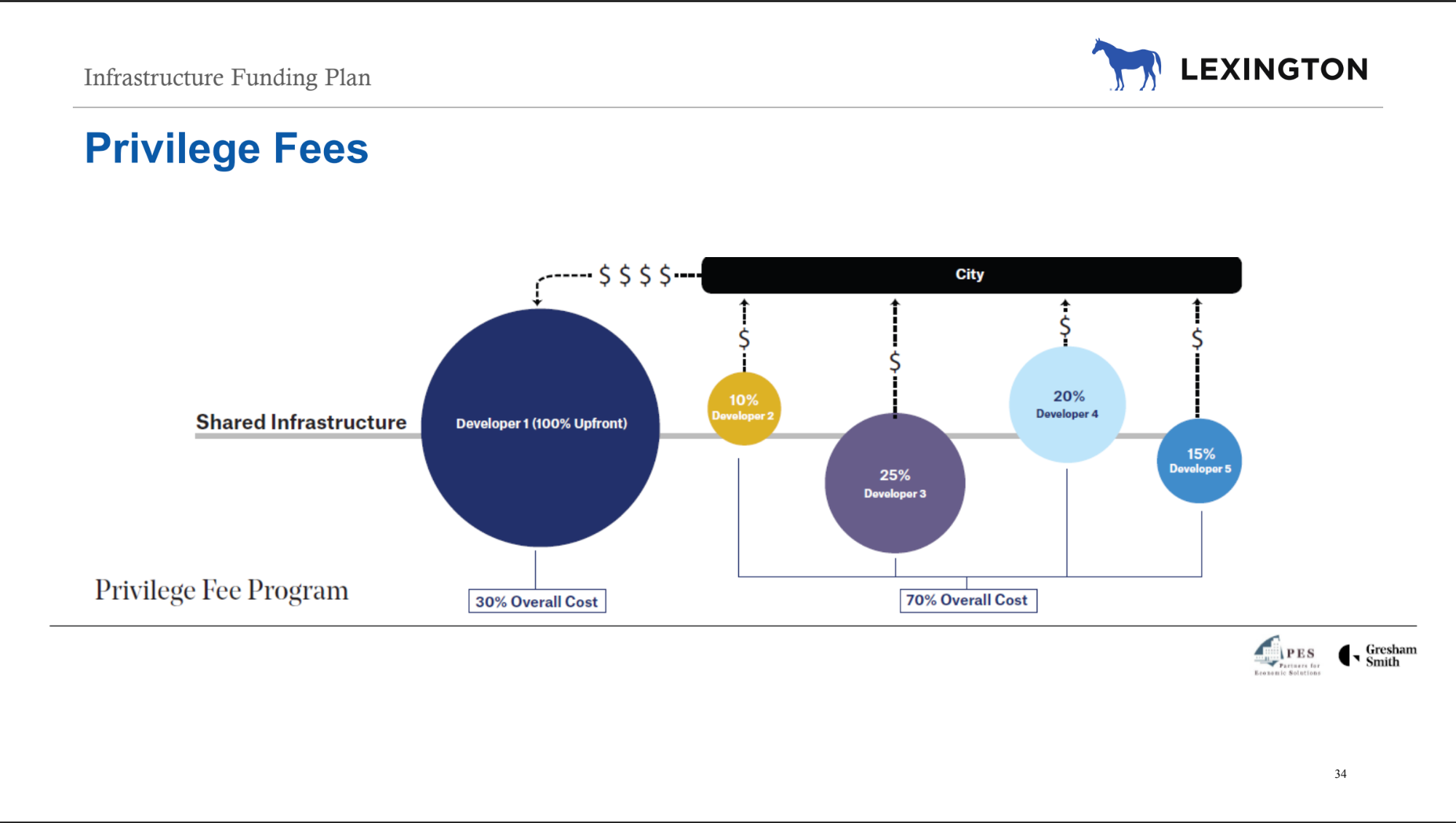
As outlined in a committee presentation included in meeting materials, privilege fees are a way for new development to bear the cost of shared infrastructure and to reimburse whoever shouldered the cost of building said infrastructure.
The new ordinance establishing the program states that privilege fees "shall be used to finance, defray, and/or reimburse all or a portion of the costs incurred by the government or a developer for the construction of sewers, roads, and other public infrastructure improvements identified hereunder that serve new development and redevelopment projects."
The process works something like this:
A developer or the local government builds the shared infrastructure, such as a sewer or road.
The local government identifies properties that benefit. They must pay a privilege fee before they can get approval for a future subdivision plan.
The shared infrastructure cost is split up between the properties based on their gross acreage. Together, they reimburse the original developer.
The local government reviews the project costs and design for compliance.
The local government would still be responsible for :
Regional growth projects
Neighborhood parks
Fire and police
Major transportation network improvements
How will future and ongoing infrastructure costs be paid?
Even beyond their initial build outs, there are ongoing operations and maintenance costs for new infrastructure.
Roads have to be repaved. Trash has be to picked up. Community facilities – such as parks and fire stations – have to be maintained.
Once they're built-out, expanded city services are projected to have a negative General Fund impact and revenues aren't expected to keep up. While privilege fees have been pitched as a way to cover upfront infrastructure costs, the mechanism for funding ongoing operations and maintenance remains an open question.
Partners for Economic Solutions, the firm presenting to the Council committee, previously suggested these costs could be paid by:
Private fees, such as those collected by Homeowner's Associations (HOAs) in new developments.
New special tax assessment districts in the expanded service areas.
Expanding existing user fees similar to LexServ for the new areas or countywide.
🫵
How can you get involved? Share your thoughts about privilege fees and ongoing infrastructure costs with your Councilmember. Find them here.
📺
Watch the meeting: The June 23rd Budget, Finance and Economic Development Committee will meet at 1 p.m. in the Government Center's Council Chamber. You can attend in-person or watch live on LexTV.
Aaron covers the Lexington Fayette Urban County Council as a City Hall Reporter for CivicLex. His background is in Service Journalism, and he’s passionate about helping Lexington residents stay informed about happenings in local government.
A proposed 'privilege fee' system for new development could eventually help recoup hundreds of millions in infrastructure costs tied to Lexington's recent expansion.
If approved and constructed, the solar installation could produce enough electricity to power about 5,300 homes. Council has expressed concern about the bid in past meetings.
In the Tuesday, January 27th Budget, Finance, and Economic Development Committee meeting, Council will hear a presentation about the potential costs for developing new infrastructure in the parts of the Urban Service Area that were expanded in 2023.