Council moves to extend Lexington's pause on data center development, restart zoning process
In a lengthy public hearing, Council heard from dozens of residents who pressed for more time to get Lexington data center regulations right.


In a lengthy public hearing, Council heard from dozens of residents who pressed for more time to get Lexington data center regulations right.

Council is holding a special meeting October 6th to hear from the public about draft zoning updates related to data centers. It could take action on the issue as well.
There's a few ways to register to vote before the October 5th deadline.

An assessment found roughly 19,430 accessibility barriers across 188 city sites, but for practical reasons, the city can't address them all at once. It's considering a phased approach to retrofits.

During its August 25th Work Session, Council will review recommendations for making Lexington's parks and facilities more accessible to people with disabilities.
As a March 31st report from consultant WT Group AEC shows, it's a huge initiative. An assessment found there are approximately 19,430 accessibility issues identified across 188 city sites.
The report notes that, to comply with the federal Americans with Disabilities Act, the local government doesn't necessarily have to make every site accessible, but it does have to make every program it conducts accessible. It explains that the ADA broadly defines that term.
"For LFUCG, an opportunity made available to the public is a program. Using a playground is a program. Cooling off at a splash pad is a program. Making public comment at an Urban County Council meeting is a program," the ADA Transition Plan report from WT Group AEC states.
"...It is a violation of the ADA if a [Lexington-Fayette Urban County Government] program cannot be accessed by a person with a disability because the facility in which the program is located is inaccessible," the report further adds.
For practical reasons, "LFUCG cannot implement all recommendations at once; no local government can," the report states.
To promote program access for people with disabilities, WT Group AEC recommends making at least one of every three recurring assets accessible, not necessarily every existing LFUCG site or asset.
"This ensures that no matter where a resident is, some LFUCG assets are near them and are accessible," the ADA Transition Plan report states.
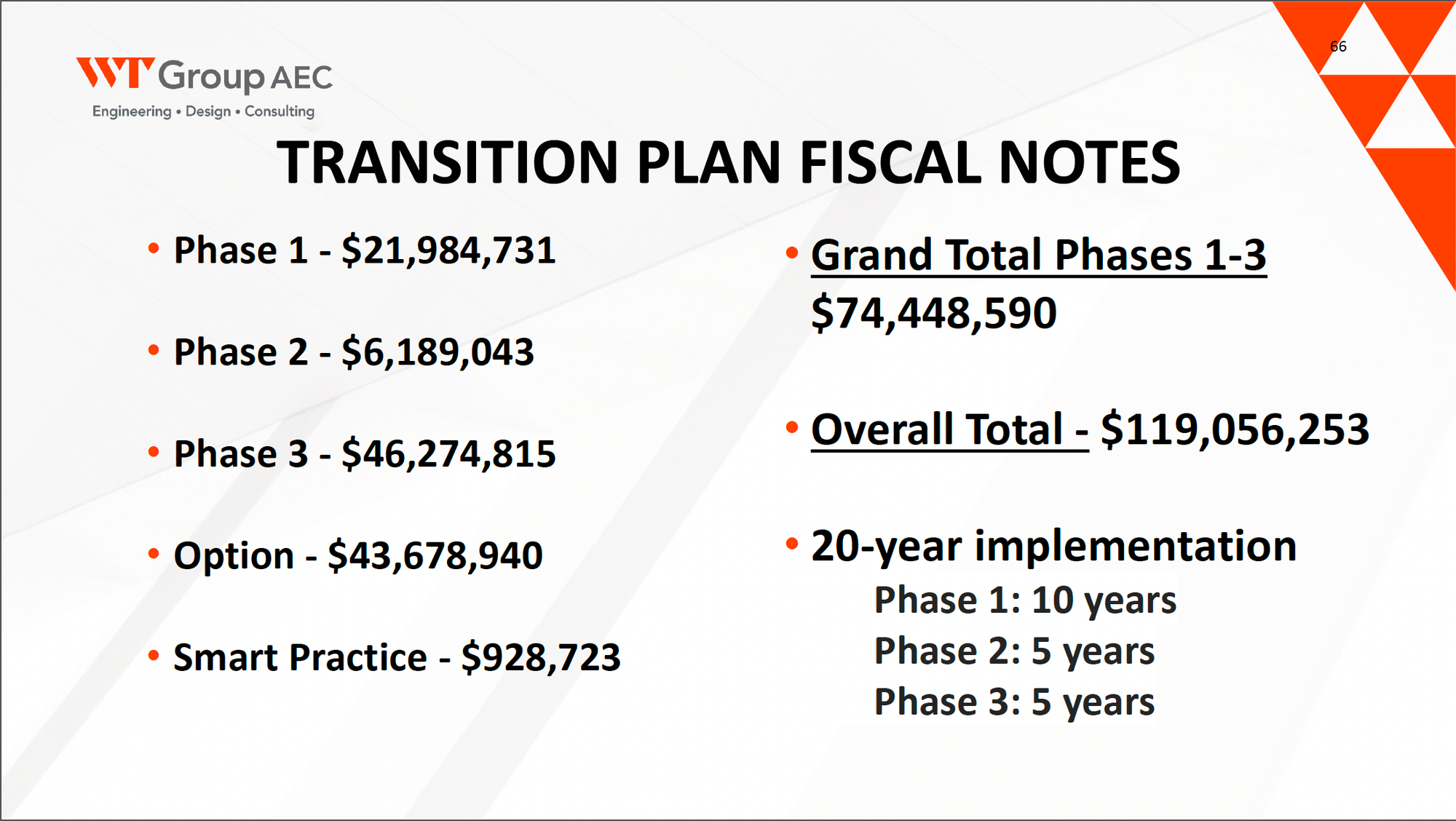
The consultant is suggesting a phased approach to accessibility retrofits, that according to this Council presentation, is expected to take 20 years to implement and cost at least $74,448,590 for phases 1-3. That's not counting roughly $43.6 million in optional costs and $928,723 in smart practices that exceed minimum legal requirements.
Beyond building and facility improvements themselves, the consultant also makes several operational recommendations. A few examples include:
Access deficits are abundant at several of the city's older buildings, including its downtown Government Center, Switow Building, Phoenix Building, its Parks and Recreation Administration Building and the Pam Miller Downtown Arts Center. Correcting their issues is difficult due to the age of the facilities, the report states.
"Many of these sites host unique services that are not offered elsewhere within LFUCG. It is critical to address the programs at older facilities and to increase access measures at these sites," the consultant's report states.
The review also examines accessibility barriers across the city's various trails, play areas, sports facilities, and picnic shelters. It flags issues for trail surfaces, suggests pursuing accessibility certifications for playgrounds, and recommends making more ballfields and courts accessible, to name a few examples.
The project's scope did not include right-of-way evaluations. The consultant recommends LFUCG develop a transition plan to address "the program of sidewalks, curb ramps, pedestrian button controls, crossings, and transit stops," as those issues often came up in staff and stakeholder discussions.
It's also worth noting there's no single source of funding for the city to pay for these improvements, but WT Group AEC identifies several potential ones. They include Community Development Block Grants, state funding, and incorporating accessibility improvements with the city's Capital Improvement Plan.

A consultant's report found Lexington needs to address roughly 19,430 accessibility issues at local parks and facilities. Now, the city needs to come up with a plan to pay for them.

Take a look at the projects being recommended for funding with the new Parks Capital Fund.


The Parks Capital Fund was approved by Lexington voters in November 2024.