Kentucky’s voting registration deadline is approaching. Here’s what to know
There's a few ways to register to vote before the October 5th deadline.


There's a few ways to register to vote before the October 5th deadline.

The Urban County Council helps craft the city's budget and has taken several consequential votes this year, from safer streets to data centers. Your vote shapes those decisions.

Lexington voters will find races for Mayor, city council, school board, three charter questions, and many other offices on their ballots this fall. Here's how to make a plan to vote.
HB 443, a State law that requires planning regulations to be "objective," could change how planning occurs in Lexington.


In January 14th’s General Government and Planning (GGP) Committee, Traci Wade of the Division of Planning presented an overview of how 2024’s House Bill 443 will affect Lexington’s process for approving development plans.
House Bill 443 was passed by the State legislature in 2024. The bill says that cities must have “objective standards” for development regulations, and that those standards must be applied “ministerially” — meaning that there should be no room for personal interpretation or discretion in how development plans are approved or disapproved.
A lot of Lexington’s zoning and development regulations are not objective under House Bill 44. Words such as “encouraged,” “recommended,” “should,” “adequate,” and more are found throughout Lexington’s planning regulations as they relate to building design, pedestrian facilities, and much more. Below is an example provided in the presentation slides.
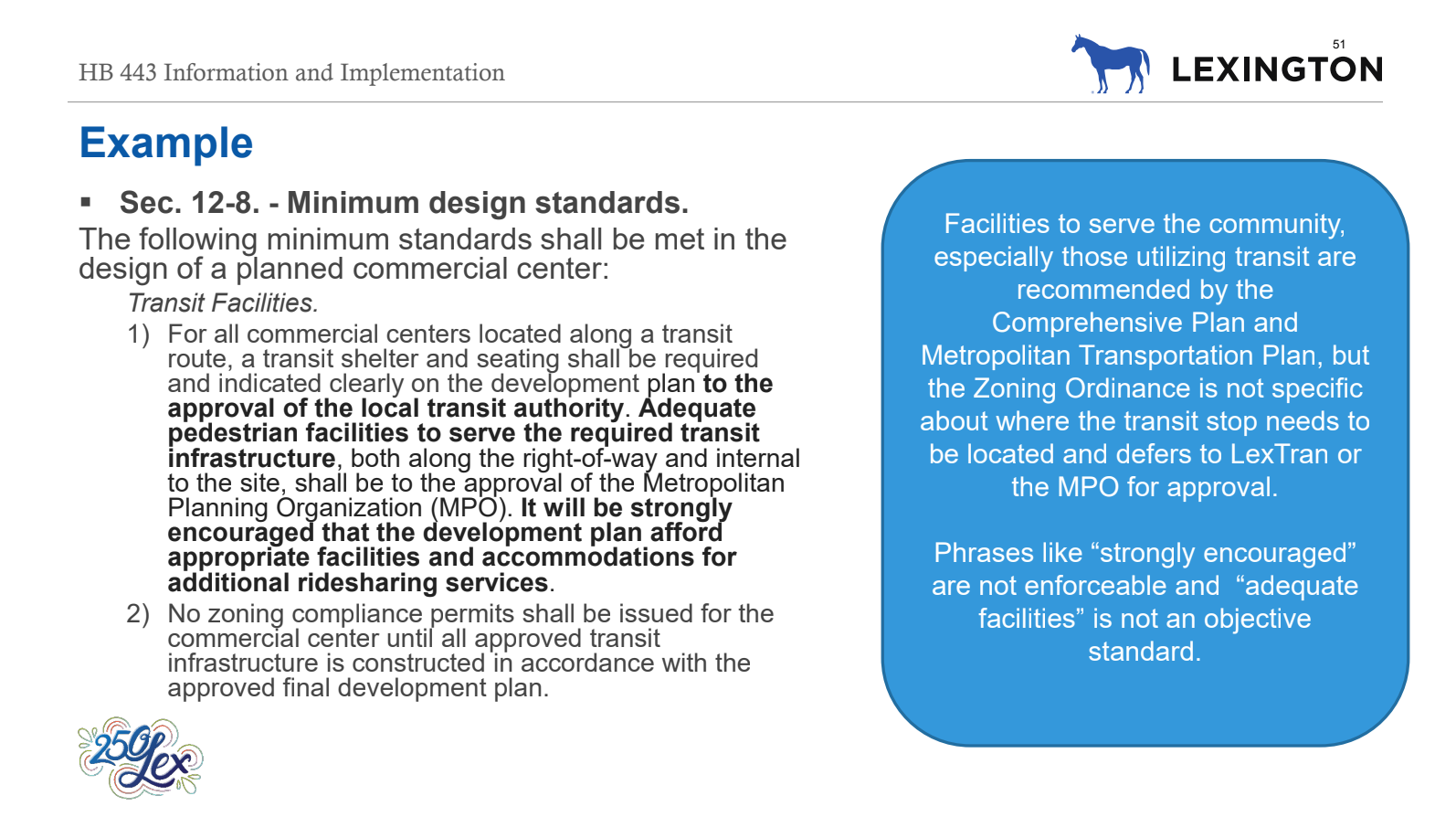
Language throughout Lexington’s planning regulations will need to be updated with more objective and measurable criteria in order to come into compliance with House Bill 443.
In terms of the process of how a development plan is approved by the Planning Commission, the only significant change is that a Final Development Plan will not come before the Planning Commission for a vote of approval.
District 3 Councilmember Hannah LeGris asked if neighbors would still be able to engage in the Final Development Plan (FDP) when a zone change moves forward.
The Division of Planning will mail resources to neighborhoods and post on Planning’s website educating residents on how HB443 will affect planning processes once they have fully amended their policies to come into compliance with the bill.
House Bill 443 takes affect on July 1st, 2025. Upcoming changes made to Lexington’s zoning and development regulations will be published in February.

It is only the second veto Gorton has issued during her eight years in office.

Under Lexington's Charter, the Mayor has 10 days to veto ordinances and resolutions passed by Council.

At a meeting this week, Councilmembers had several questions for city Planning staff about proposed changes to Lexington's zoning rules for data centers. What's next?

A council committee will get a status report on the study, then the public is invited to an open house to offer feedback.