The city expects $30 million over 18 years. It's outlined several priorities for how it wants to spend that money, with a focus on treatment and harm reduction.
When floodwaters rushed through their rural Clay County property in February 2025, the Salmons family didn’t apply for federal disaster aid. The storm destroyed their farm equipment and the bridge to their home, but they knew others were hurting more.
“So many people lost their lives, lost their whole homes. It didn't get in our house. It wouldn't have been right to file,” Sharon Salmons says. “We’re too old to farm now anyway.”
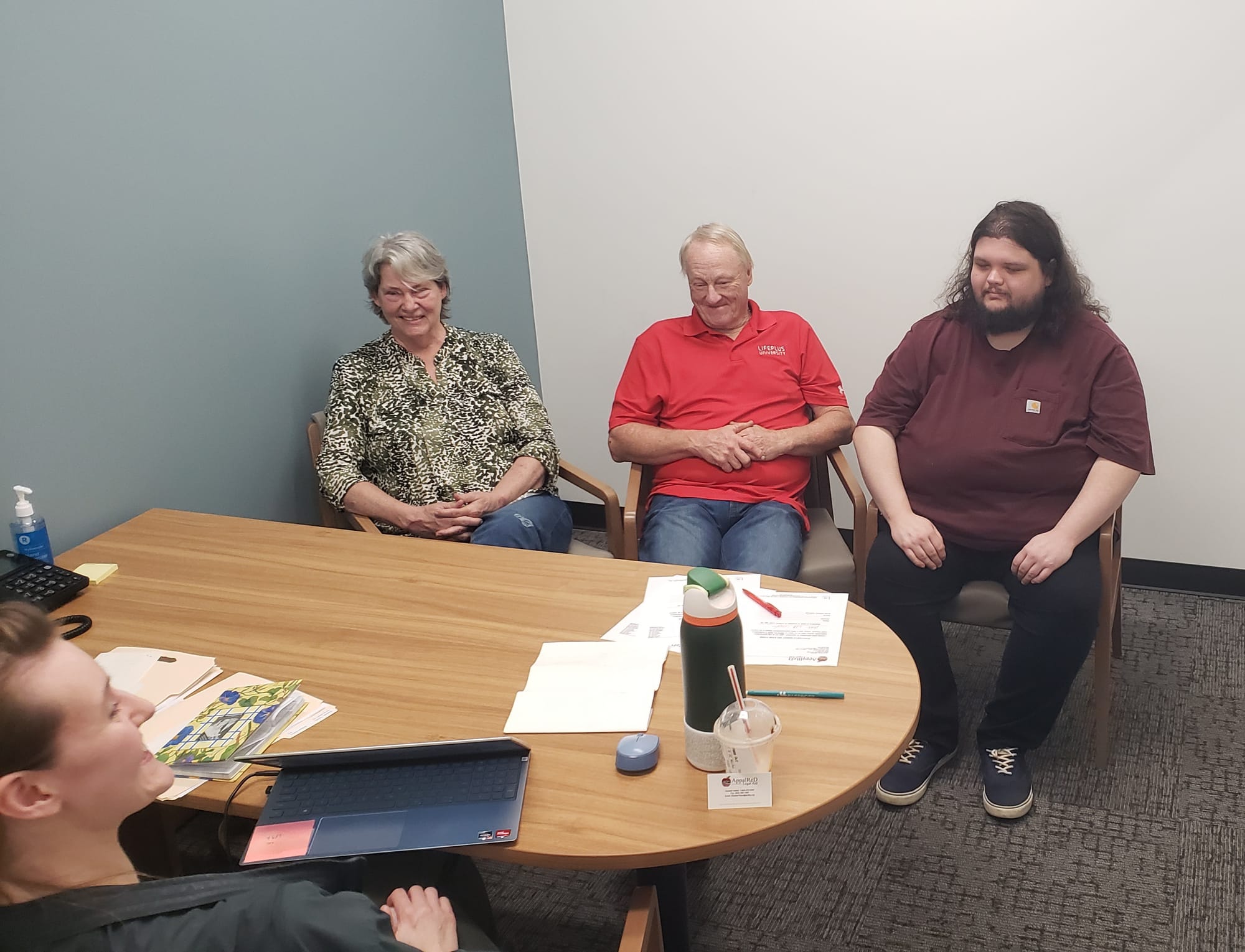
But she, along with her husband and grandson, still drove two counties away to a free legal clinic hosted this month by the nonprofit law firm Appalachian Research and Defense Fund of Kentucky, known in the region as AppalReD.
“We have several pieces of property. We don't want it sold; we want it left for our heirs. If they need a place to land later on, if they lose their homes, we don't want them to be homeless,” Salmons says.
If the Salmons wanted to apply for Federal Emergency Management Agency (FEMA) aid, however, they would need to prove they legally own their land. In much of Appalachia, that’s not always straightforward. Generations of inherited land, informal transfers and poorly written wills often leave property titles “tangled.”
Sharon Salmons came to the AppalRed clinic with her husband Timothy Salmons and their son Caleb Coots. Anabel Peterman
“To be eligible for FEMA assistance, you need to prove things like your identity, your occupancy of the disaster-damaged residence,” says Whitney Bailey, AppalReD’s Disaster Response Project Director. “And then, if you are a homeowner, ownership.”
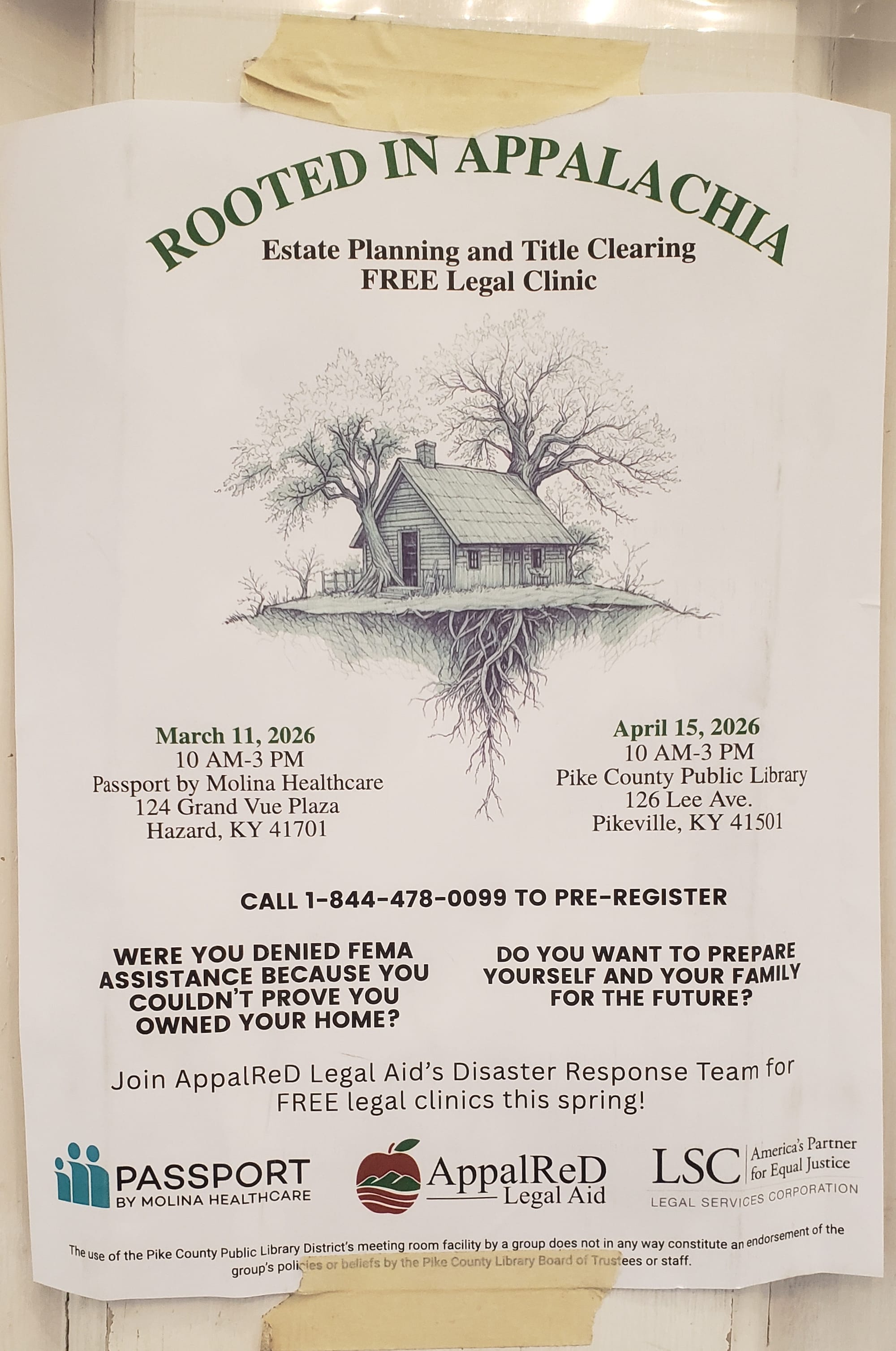
That’s where AppalReD’s legal aid comes in. Inside the Passport by Molina Healthcare Hazard Resource Center, staff and volunteer attorneys sat down one-on-one with property owners and heirs to sort through complicated or unclear property titles that were making it difficult for them to access FEMA aid. The Rooted in Appalachia clinic, like most of AppalReD’s pro-bono services, is free to people across the region who meet certain low-income requirements. Clinics like these aim to protect households from future flood complications, as well as potential predation from real estate companies.
AppalReD has put on similar estate planning and title clearance clinics for years, but this is the first one hosted specifically by its disaster response team. It comes at an unassuming point in time: No one is wading through floodwaters in downtown Hazard, and FEMA application deadlines have long since passed (though appeals and payments continue to be processed). But officials say the relief effort is still ongoing.
'The once in a thousand years flood came twice'
Disasters that once seemed rare are becoming more common in Kentucky, which has been hit hard by numerous natural disasters in the last five years. Eastern Kentucky in particular was ravaged by floods in 2022, and again in 2025. Dozens died, and thousands were temporarily or permanently displaced. “The once-in-a-thousand-years flood came twice,” says Charnel Burton, AppalReD’s pro bono director.
In response to the 2022 floods, FEMA paid out more than $11.8 million in housing assistance to Perry County alone. That covers the 116 homes within the county reported by FEMA as destroyed, as well as the 1,310 that sustained at least minor damage. Getting that money as an individual or business, though, isn’t as easy as it sounds.
Not every disaster survivor can prove they own their home. Often, the person applying for aid isn’t clearly labeled on the title, even if the property has been passed down or gifted to them. This situation is called heirs’ property, which is a type of tangled title.
Rhonda Chaney is a flood survivor who was tied up in a title issue and couldn’t successfully apply for FEMA aid. This one wasn’t specifically heirs’ property– she was living in a friend’s property at the time of the July 2022 floods. Afterwards, she had no choice but to continue living in that friend’s home, despite mold caused by the water damage.
“Everything that could help me, couldn't, because I had no income,” Chaney says. “I had no income because I was in the process of getting my disability. When the flood hit, I had not driven since … September of ‘21. So, I didn't see a reason to change my address [on my drivers license]. There were different things that you had to have in line.”
She also faces an heirs’ property situation with her deceased dad’s property. That land has 14 heirs, all with 100% interest. And because of missed child support payments, the state of Kentucky also has a lien on the property; it couldn’t be sold as is without a vast amount of taxes and state claimed funds being taken out.
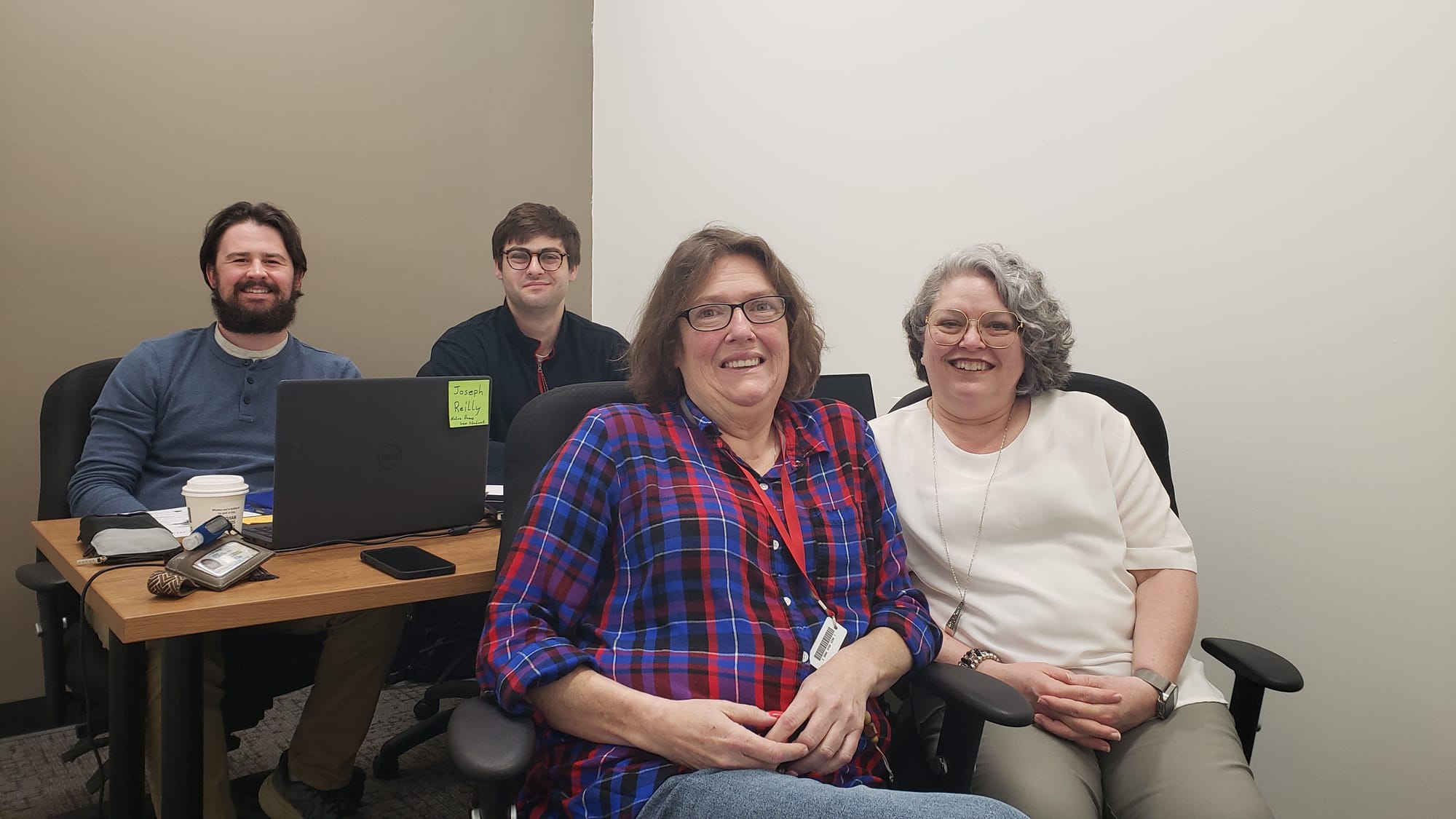
Rhonda Chaney (left) and Charnel Burton (right). They were shadowed by Notre Dame law students Joseph Reilly and Andrew Coffey. Anabel Peterman
At the clinic, Chaney and AppalReD figured out together that the statute of limitations had passed, with more than 15 years since the judgment was entered. As for the flood-damaged home, AppalReD helped her file appeals for FEMA aid; Chaney says these didn’t go anywhere, but she was still grateful for the free assistance.
The trauma of that flood stuck with her, as did the water damage on the house. But federal disaster aid didn’t last.
“What do you do when the Red Cross shelter closes … and you have to go back to that flooded home and sleep on those wet mattresses covered in plastic, so that you have a place to sleep? Who worries about people having to do that, that are breathing in the mold?” Chaney says.
“Because after the flood, then comes the mold.”
Bailey is originally from Lexington, Kentucky’s second-most populous city. When she moved to work at AppalReD’s Prestonsburg office, reality hit her hard. Even with most homes at risk due to climate change and lying low in the floodplain, people in the floodplain can’t afford to build a life elsewhere.
“My friends and family in Lexington, they would say, ‘Why don't these people just move?’” Bailey recalls. “And I’m like, they can’t. Where are they going to go? The housing market, there's no housing stock … [You] have to pay for gas, pay for boxes or tote bins to pack your things, and so many other expenses that add up really quickly.”
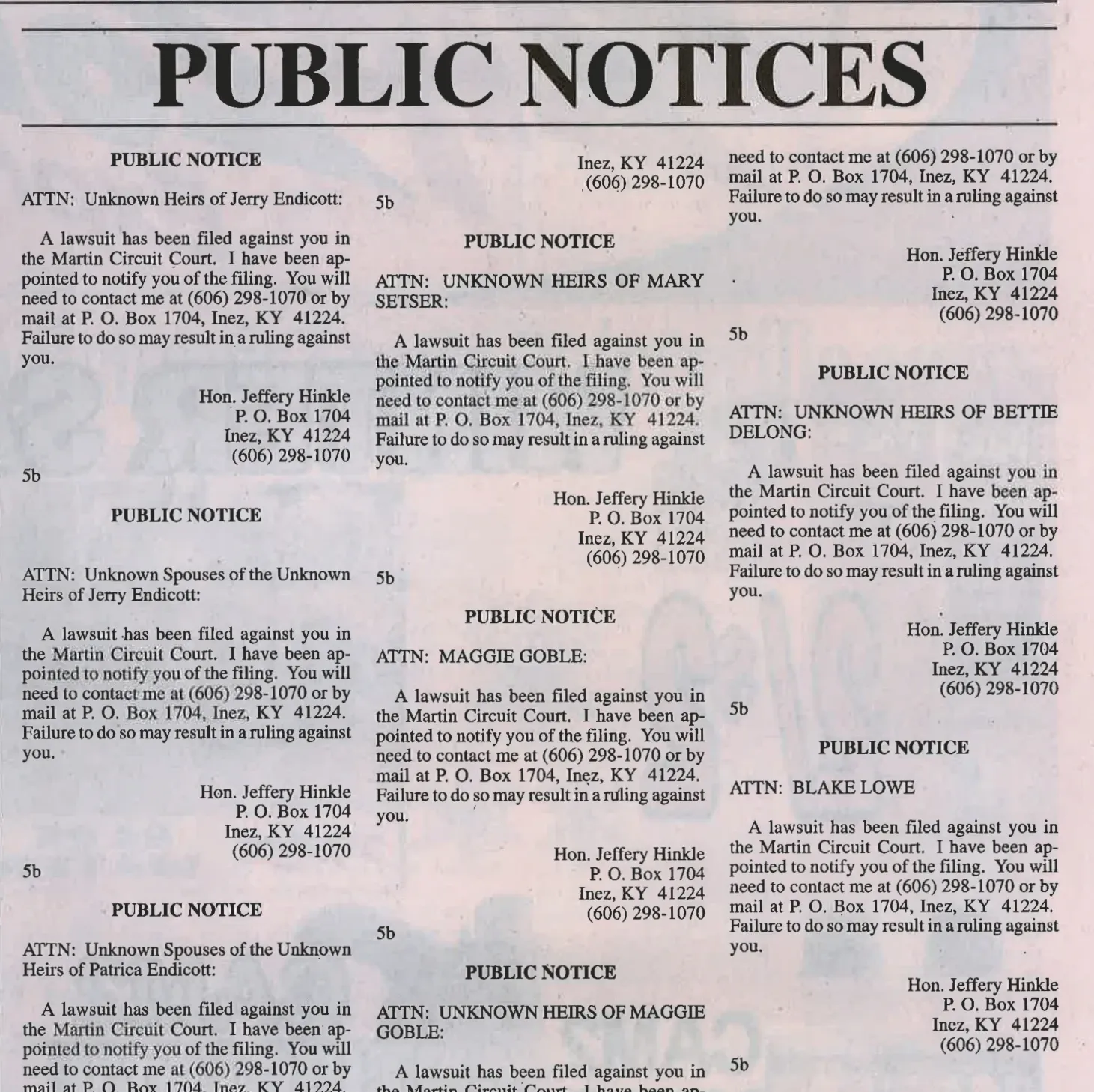
“Public notices section of the January 31, 2024 publication of the Mountain Citizen, a newspaper in Martin County, where Warning Order Attorney Jeffrey Hinkle posted more than a dozen foreclosure notices to unknown heirs' property owners.” Courtesy Kevin Slovinsky
Appalachia: A hotspot for heirs’ property
Normally, when someone dies, their assets get divided up per their written will. When a property owner dies without a well-written will, the land is passed down to the heirs – with the original property owner’s name still on the title – and it’s unclear who actually owns what. That creates a legal situation known as heirs’ property, and it can get complicated quickly.
“We definitely utilize [LiKEN] as a resource, and especially if we have funky cases, we’ll shoot an email over to Kevin [Slovinsky, the director of LiKEN’s Land and Revenues Program] and say … what are your thoughts? We’re a little stumped.”
LiKEN first began researching these title issues in 2020; in conversations with Black farmers in central Kentucky, they found the biggest barrier to federal farmer’s aid was clouded titles.
While heirs’ property often occurs when someone dies without a will (which triggers a specific legal process called intestate succession), many wills are also unintentionally written in a way that creates heirs’ property, Slovinsky explains. If the land isn’t divided up, each heir will have equal claim to all the land, opening the door for complications.
“In Eastern Kentucky, the reason that there is so much heirs’ property is because there's a very high rate of either intestate succession – dying without a will – or wills that are poorly written.”
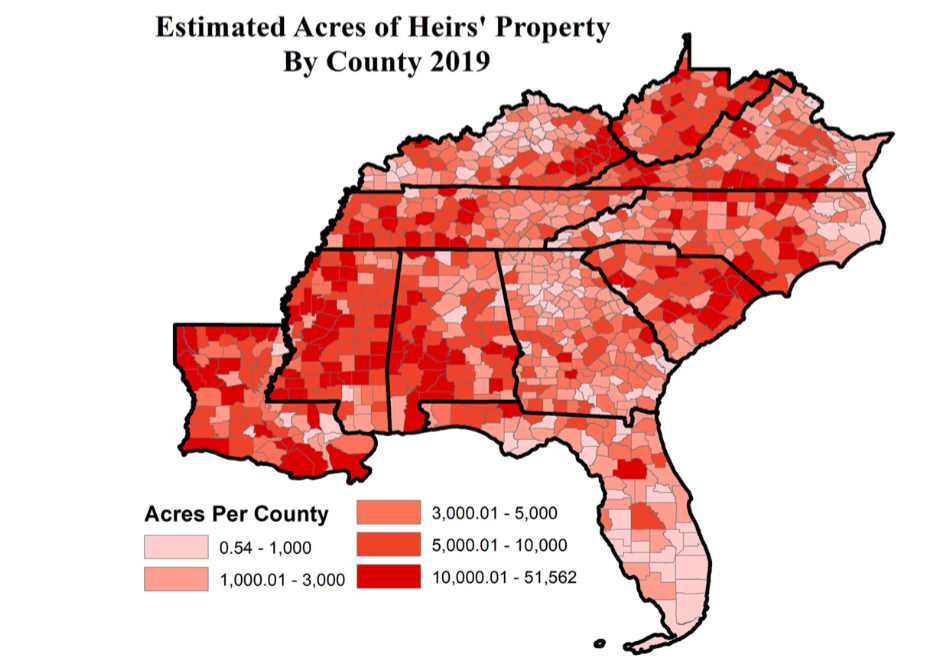
Slovinsky says the three biggest hotspots for heirs’ property issues in the United States are the Deep South (specifically among Black families), east Texas and central Appalachia (West Virginia and eastern Kentucky).
And in all those areas, having tangled titles can leave families and heirs vulnerable to bad actors. In other regions with high property value, like North and South Carolina, real estate companies exploit Partition Actions to become partial owners (co-tenants) of the property, and then force it to be sold at auction. In eastern Kentucky, it’s more common for heirs to face property tax delinquency foreclosure.
Back in 2024, Slovinsky got a call from an elderly Black woman in Kentucky who had found herself tangled up in a complicated legal situation made worse by what he describes as a “privatized market for property tax debt.”
The woman, who was a co-tenant of heirs’ property, had been preyed upon by an out-of-state real estate company that aggressively buys up certificates of delinquency across the state. Because the deed was in her aunt’s name, she and her relatives – all of whom were on fixed incomes – had difficulty paying the property tax on it, and the land faced foreclosure. A third-party company had called her telling her that it would pay the taxes on her family’s behalf: The woman was confused why a company would buy the debt, as all she had been told was the tax had been paid.
Estimated acres of heirs’ property by county. Seen in “Identifying Heirs’ Property: Extent and Value Across the South and Appalachia." Journal of Rural Social Sciences
Companies try to buy up heirs’ property this way much more than they do land with clear titles or commercial property, Slovinsky explains. And when the property is being foreclosed upon, the heirs don’t always figure it out because the title is clouded.
“The [county] property valuation administrator, who is the one in control of assessing property values, regularly does not have the accurate mailing address or the contact information for the owner because they don't know who the owners are,” Slovinsky explains. “Oftentimes [for] heirs’ property, the mailing address is either the address of the property itself, where there is no home and no post box, or it is a geographic location.”
For example, he’s seen mailing addresses as vague as “The Right Fork of Maces Creek,” referencing a creek in Viper, south of Hazard. Since most of these letters don’t make it to the co-tenants of the property, they may not figure out the property is being foreclosed upon until it lands in the public newspaper.
Historically, coal and oil companies have taken advantage of these circumstances.
“Selling heirs’ property is very difficult, but it only takes one heir to lease a property,” says Slovinsky. Just one heir (including a real estate group) can lease it out to mining companies. “In the absence of a clear owner, extraction companies pretend that they own it.”
🫵
Learn more For more information on heirs’ property in low-income communities, view Next City’s From Tangled Titles to Shared Prosperity webinar, in partnership with Results for America.
Bailey says these higher ground communities will greatly benefit eastern Kentucky’s low-income residents, but it’ll take a long time.
“It's 2026, and that [flood] was from July 2022. People have to live somewhere in the meantime.”
For Chaney, that meant continuing to live in a mold-infested house, which she says would’ve cost more money to repair than it’d be to replace. Now, she’s fortunate to live on the Knott County Chestnut Ridge High-Ground Community site; the site was dedicated and families began moving in last year.
To purchase one of the homes, flood-affected households can submit buyer inquiries and work with FAHE’s homeowner assistance program, subsidizing costs with block grants. Like AppalReD’s clinics, the program is specifically for low-income residents; they must meet program affordability requirements, demonstrate an unmet need, and provide accurate documentation of potentially duplicative assistance.
Every year, 20% of the mortgage balance is forgiven, so after five years, she will own the home outright. For someone who lost what little she had in 2022, it means the world.
“I have a home. It's been three years in the making, but I have a home,” Chaney says.
Chaney’s new home is at much lower risk of being hit by a disaster, but that chance isn’t zero. She now knows proper estate planning will help ensure that she and her descendents never have to deal with the clouded title struggles she faced.
“When I go back home, I'm gonna talk to all the people that have the same type of house I have, and let them know that there is a free clinic that will help them do this. And they won't have to worry about going out and paying somebody to do it,” Chaney says.
Burton from AppalReD sat with Chaney and figured out the estate planning for her new higher ground home together. “It's important that your wishes be made known in a way that your heirs can do what you wanted them to do,” she says. “That your property can go where you want it to go, and you make sure that your wishes are honored after you pass.”
Anabel Peterman is CivicLex and Next City's Rural-Urban Report Fellow. She covers stories that explore the complexities of rural-urban dynamics playing out across the Central Kentucky region.
Lexington used a $1 million public contract to wipe out millions in hospital bills. In Paducah, organizers are crowdfunding — hoping to clear a fraction of that total without city hall.
The Blue Sky Activity Center is an industrial area off Athens-Boonesboro near I-75. It was brought into the Urban Service Area in 2024, and is being planned for redevelopment.