Lexington has a new snow and ice plan. See what that means for your street
Lexington crews will treat priority streets earlier during winter storms. What else will be different?


Lexington crews will treat priority streets earlier during winter storms. What else will be different?

The Task Force has 5 priority and 15 long-term recommendations to address homelessness in Lexington.

After multiple challenging winter storms, Mayor Linda Gorton said she was "tearing up" the city's snow plan and starting over. Council will get a look at what's new Tuesday.
With disability rates on the rise and paratransit still falling short, Lexington is investing in two microtransit initiatives developed by local nonprofits.


This story was produced as part of a joint Equitable Cities Reporting Fellowship for Rural-Urban Issues between CivicLex and Next City.
For decades, Mary Evans has lived with postural orthostatic tachycardia syndrome, or POTS. The risk of fainting from the blood circulation disorder, alongside her other autoimmune conditions, makes it unsafe for her to drive. So to get to and from work every day, she relies on Wheels, the paratransit service run by the local transit authority, Lextran.
“It may not be fast, but they will almost assuredly get you where you need to go,” says Evans, a disability advocate in Lexington. The door-to-door service, available by reservation the day before, can be a lifeline for disabled individuals who need to reach their job, school, a grocery store or a doctor’s appointment.
But delays are common. According to the Herald-Leader, Wheels’ monthly on-time performance fell as low as 50.5% in October 2022: half of the rides scheduled that month showed up late, took too long to get to the destination, or didn’t show up at all.
Fred Combs, general manager of Lextran, says those performance issues were partly due to supply chain disruptions during the Covid-19 pandemic. “Once those supply chains got worked out, then we could make this investment to get our fleet built out,” he says.
Since then, Lextran has integrated 21 new ADA-compliant vehicles. And according to its 2025 fiscal year annual report, on-time performance trended above 80% between April and August of last year (the latest statistics available), for the first time since before 2023. “We're much better, not as good as we want to be,” Combs says. “We still have room for improvement.”
But Covid-19 affected a lot more than the supply chain. Evans says she’s noticed more and more people become disabled after the pandemic, including many who have developed POTS after being diagnosed with Covid-19, and especially after long Covid. Patients with long Covid have also seen high rates of long-term disability in general.
Disability rates have risen nationally, at the same time that America’s elderly population has continued to grow rapidly. Most cities across America are already failing to adequately serve their mobility-challenged residents, experts say.
“[Paratransit] is underfunded to the point where there's not enough to respond to the need,” says Dom Kelly, the president of the nonprofit New Disabled South, which works to advance disability rights across 14 states in the American South.
“That means that people are waiting longer for it, they're booking paratransit but it's not showing up, or it's showing up late. They're overbooked, they have to schedule days in advance, things like that.”
To fill the service gaps caused by Wheels’ performance issues and the rigid nature of their fixed-route bus service, Lexington transportation officials and community leaders are exploring new models to supplement current options. These include two flexible and individualized microtransit services — created in partnership with local community groups —that can expand opportunities for people who can’t drive for any reason.
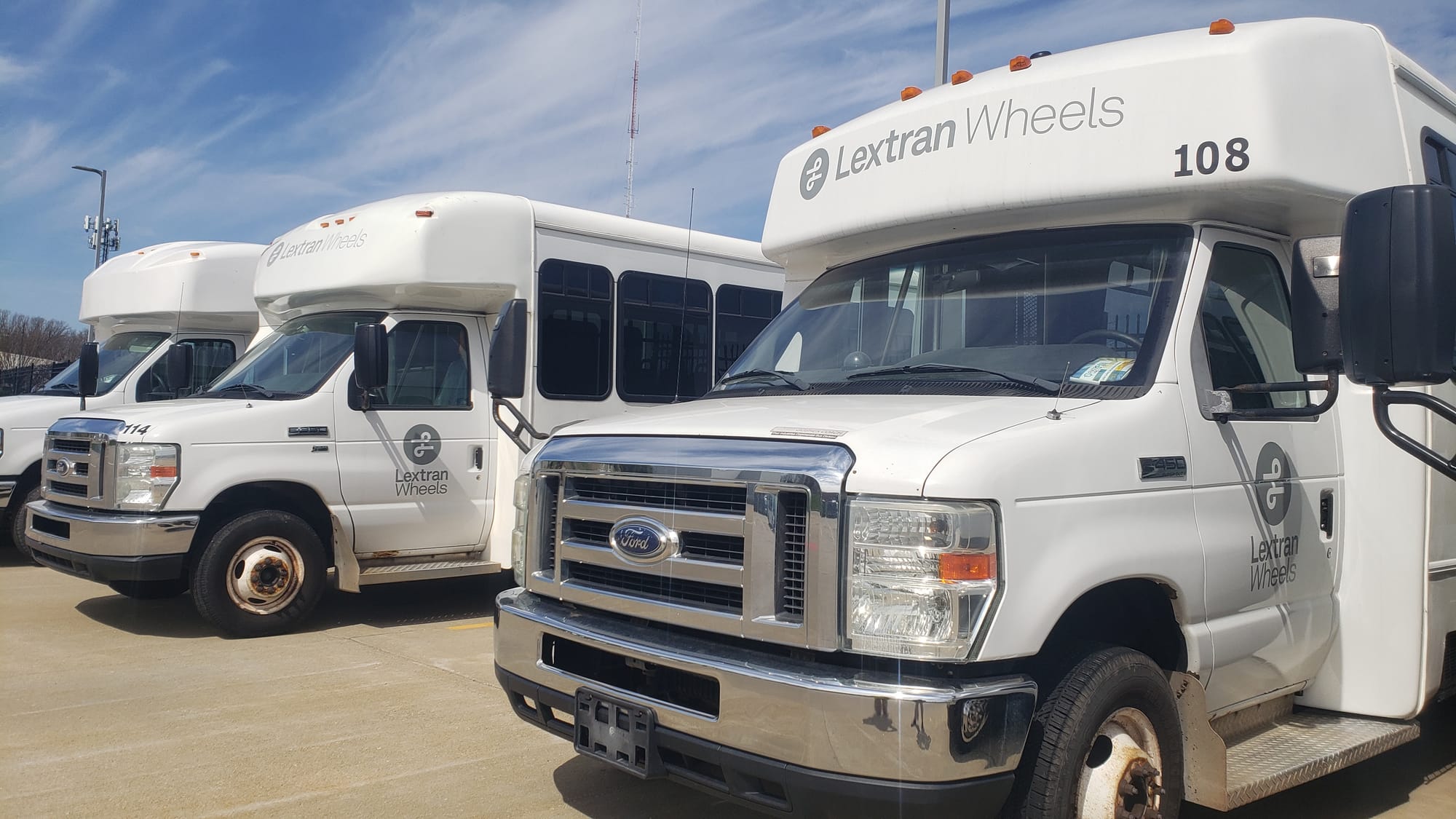
Paratransit is a form of public transportation serving people who can’t take a fixed route bus service due to a disability. In Lexington, if a resident can’t safely reach their nearest bus stop due to mobility challenges, they can request a Wheels driver to come to their doorstep and assist the passenger into the Wheels bus.
“The vehicles are smaller, the rides are booked a day in advance,” explains Combs. “It's a little bit more expensive fare-wise — it's $1.60 as opposed to $1 on a fixed route. But the difference is, it's countywide, so you can go anywhere in Fayette County so long as you booked the trip the day before.”
Despite the performance improvements that came with expanding its fleet of buses, Wheels still falls below RATP Dev’s (the service operator that has worked on contract with Lextran since 2022) operational goals of 90% on-time performance.
Evans knows from experience how badly a trip on Wheels can go awry. “There are a lot of different variables, and every day is different,” she says. “It just has the opportunity to fall apart.”
One of those factors, she says, is inefficient route planning by drivers who don’t know their way around the city well. If a rider is unlucky, they might end up with a driver who takes them in circles. “There was one day I was on there for over two hours,” she recalls. “I passed Rupp Arena three times – and over two hours after I'd gotten on the bus, we were driving right past my street again before they took me to work. I mean, it is ridiculous and silly.”
Evans has ended up paying out of pocket for an Uber or Lyft ride when her Wheels ride falls through. The Wheels drivers are generally kind and communicative, she says, and she’s built an established relationship with them, so they often call her directly if running behind.
But that’s not a viable solution for every disabled resident. A power wheelchair user, for example, can’t rely on taxis or rideshares; the only public transportation in Lexington with sufficient power to haul it is a bus. Lextran’s regular buses are also wheelchair accessible, but not every person can get transportation to the bus stop.
Emily Elliott is Lextran’s director of planning and community development. She’s well aware of how much improvement Lextran’s paratransit service needs – as well as the long-term consequences of its performance issues.
“One of the biggest breakdowns was the perception of the service and the trust that clients had, either in the service or the employees,” Elliott says. “When that trust is degraded, something goes wrong and you're like, ‘You know what? That's it … I don't trust them. I don't trust the system.’”
It’s especially difficult, Elliott explains, to regain the trust of a particularly vulnerable demographic like the disabled community.
“We have to be sensitive to [the fact] that if Wheels is not there to provide transportation to many of the clients, there is no safety net. There is nothing else. So when you lose the trust with someone that knows that they don't have a safety net … it is profoundly impactful.”
The new vehicles are a big step in the right direction, she says, in addition to bolstering their staffing. And the newly-renovated transit center downtown is now more accessible in a few ways. The customer service area is now sheltered from noise, making it much easier to hear; the bathrooms are more wheelchair accessible than before, and information on bus routes is much more attainable thanks to button-operated kiosks. But all that matters most for someone taking a typical bus, not paratransit.
Pastor Adam Jones has seen that trust break down among members of his church community.
Years ago, a disabled member of a local church made what was supposed to be a quick trip to Walmart. “Wheels was late picking him up, so he called, and Wheels said it was too late,” recalls Jones, who leads Open Door Church and serves as co-chair of the local interfaith coalition BUILD. “He was in a wheelchair, the police couldn't get him in a car. He had to stay the night at Walmart overnight because there was no way to get home.”
BUILD is a direct action organization that aims to address the root causes of community problems. Open Door Church and 24 other congregations in the city work together on policy reform for housing, addiction services, and – as of late – public transit.
“Over and over, anecdotal stories like this kept popping up in our listening sessions,” Jones says. “That's when we decided to tackle transportation.”
In 2021, BUILD voted to begin exploring solutions. After conversations with the mobility company VIA, they settled on microtransit. Similar to an Uber or Lyft, microtransit services provide individual rides in regular car- or van-sized vehicles.
BUILD’s vision was on-demand, curb-to-curb, affordable service with wait times under 30 minutes. Organizers modeled the system after cities with established microtransit like Wilson, North Carolina and others with emerging services like Arlington, Virginia.
Following a feasibility study in August 2025, Lexington Fayette Urban County Government’s City Council voted that December to contribute half the cost of a $1.2 million pilot. The program will kick off in 2027.
“The only real restriction is geography. We need to be moving within the zone,” Combs says. The zone in question is on the northwest side of the city, stretching between Newtown Pike and Versailles Road; many people in this area live at least a mile away from their closest bus stop.
“We'll take you to a bus stop, and you can catch a fixed route throughout the city, but microtransit itself is geographically constrained within that zone.”
Jones and Lextran officials emphasize that microtransit isn’t meant to replace paratransit, and can’t serve all residents with disabilities. Its goal is to be a bridge for some people to better access amenities and fixed routes. And able-bodied people can use it, too.
Lexington also has another form of microtransit available. United Way of the Bluegrass’s 211 program serves Fayette and some surrounding areas with on-demand transportation. The federal initiative provides free rides for people (in the form of Lyfts), often those with disabilities, traveling for essential health services or work.
Patrice Muhammad is United Way of the Bluegrass’s vice president of community impact. She notes that their 211 program will not work for everyone, as it requires an individual to be able to enter the car without assistance from the driver.
“We're part of a solution, but we're also part of a network. And that's what happens when people call 211– based on your abilities, we're able to recommend you to the right resource,” Muhammad says.
The initiative began as a result of people without cars having trouble accessing public transportation. Muhammad says the service intersects with affordability needs.
United Way of the Bluegrass also received funding from the local government last year to expand its transit programming and conduct a pilot study on their own user base. They aim to collect anonymized information on their riders and where they’re taking the 211 service, as well as their residential ZIP codes.
“If we find that people are catching a bus to a particular location and then getting a Lyft ride – we're trying to figure out how people are utilizing the system. And then, we'll be able to figure out how people are utilizing our services and figure out what the gaps are in the system.”
Kelly, the founder of New Disabled South, says late paratransit rides aren't just a Lexington problem. In Atlanta, where the nonprofit is based, MARTA Mobility was late to pick up disabled riders thousands of times last year. It’s a similar story in Dallas, where vendor changes have contributed to low performance and late rides.
“[Kentucky] has many of the same issues as other Southern states, unfortunately, where transit – and really, most infrastructure – is pretty woefully underfunded and under-resourced, especially accessible infrastructure.”
In fact, it’s a national problem. Long wait times are common for Boston and Sacramento paratransit riders. In Denver, a study by the Transportation Research Record concluded that the “the mean paratransit trip time is almost twice that of the mean car travel time.” That means on average, a 16-minute drive by car would be 25 minutes by paratransit service. But that average had a high standard deviation, with the study reporting “high variability and uncertainty associated with paratransit trip times.”
As a consequence, Kelly says people using these services often have to plan their entire day around the bus schedule, all for one appointment.
“If your paratransit ride is 40 minutes late … it's like you don't have transportation,” he says. “This is something we hear from folks all the time.”
While paratransit services provide a vital lifeline, disability advocates believe they shouldn’t be the only solution.
“It shouldn't be that we need a separate parallel system that treats disabled people separately and as an afterthought,” Kelly says. He says equity begins with making mainstream public transportation systems, including typical fixed route buses, more accessible. That can include wheelchair ramps, curb cuts, tactile paving, working elevators in train stations, low-floor buses, accessible signage and trained staff.
“There is a view oftentimes that because we have paratransit, that it's enough. That because it exists, simply exists, it's fine. The reality is that … it is not enough,” Kelly says.

The program would be piloted in northwest Lexington with the goal of serving high-need populations with on-demand service.

LexPark seeks to raise rates at its downtown garages. It says the additional revenue is needed to help cover rising costs and expensive maintenance.

In Lexington, 36 randomly-selected residents took part in one of the country’s first civic assemblies to recommend changes to the city’s governing charter.

Heirs’ property issues can block disaster survivors from accessing FEMA assistance. In Eastern Kentucky, free legal clinics are helping families clear titles and protect inherited land.