Kentucky’s voting registration deadline is approaching. Here’s what to know
There's a few ways to register to vote before the October 5th deadline.


There's a few ways to register to vote before the October 5th deadline.

The Urban County Council helps craft the city's budget and has taken several consequential votes this year, from safer streets to data centers. Your vote shapes those decisions.

Lexington voters will find races for Mayor, city council, school board, three charter questions, and many other offices on their ballots this fall. Here's how to make a plan to vote.
On Tuesday, Council will consider options for local "ad valorem" property tax rates. How could they affect your bill?

During an August 11th Work Session, Council will take an initial vote on ad valorem (property tax) rates for fiscal year 2027.
As explained by Council presentation materials, an ad valorem tax is a tax based on the assessed value of an item, such as real estate or personal property. It covers things like homes, vehicles, and similar property.
The ad valorem tax is assessed on every $100 in value of owned property.
In Fayette County, ad valorem tax revenues are split between multiple agencies, with the bulk (63.14% in fiscal year 2026) going to the local public school district. Other taxing entities, such as the state government and Lextran, also levy property taxes.
Property taxes also help fund the Lexington-Fayette County Urban County Government, with 5.93% going to the city's General Fund in fiscal year 2026 and 13.69% going to its Urban Services Fund, which covers waste collection, street cleaning and street lights, according to presentation materials.
During the meeting, which will take place at 3 p.m. Tuesday, the Mayor's administration will present ad valorem tax rate options for Council to consider, as well as its own recommendations.
Council will take an initial vote to set the rates, followed by first and second readings. The second reading, held on August 27th at 6 p.m., will include a public hearing before the body takes a final vote on the rates.
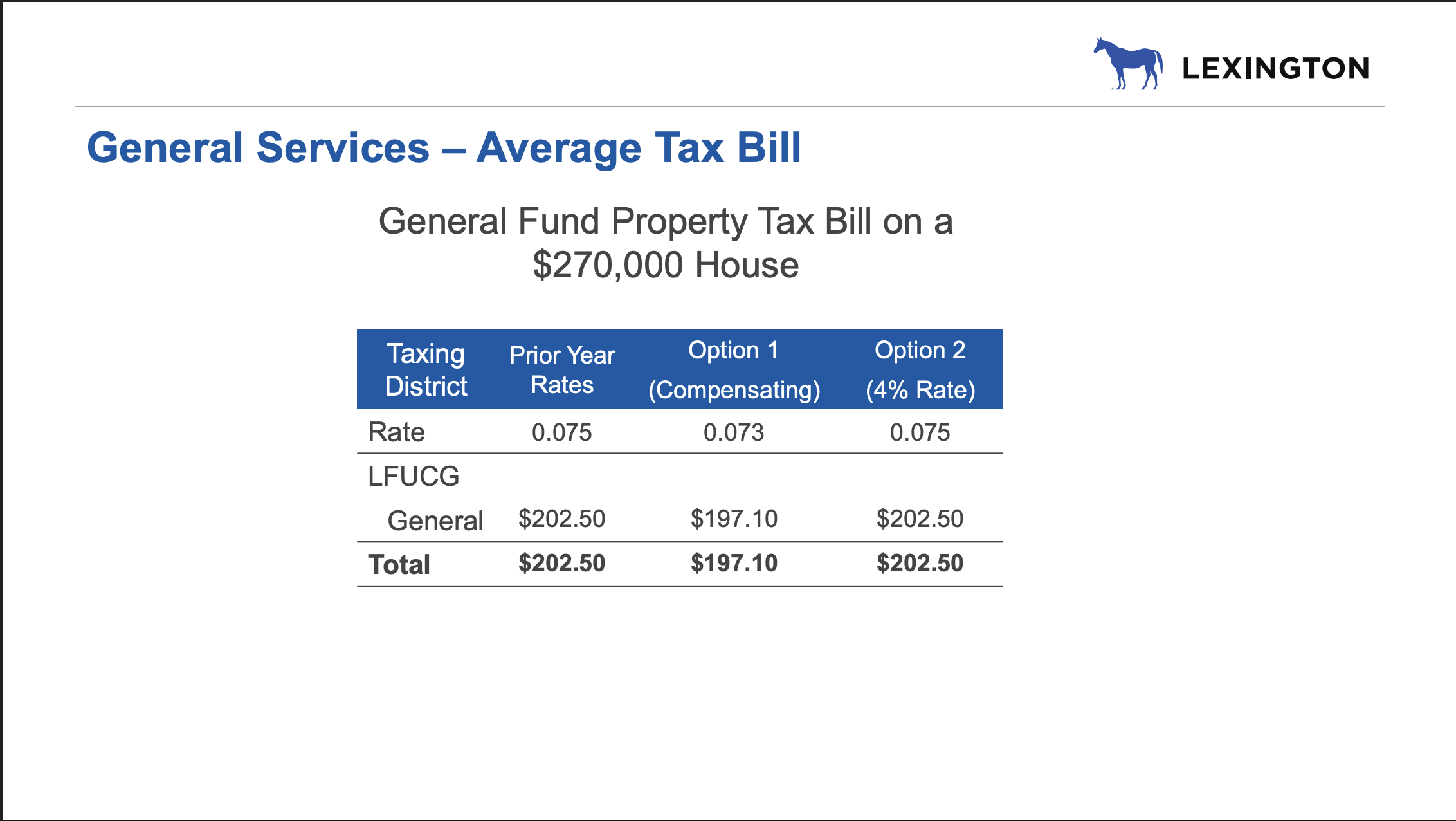
Presentation materials lay out the following tax rate options for Council to consider for the city's General Fund:
If the city sets the rate above 4%, the rate would be subject to voter recall within 50 days if a petition is signed by 10% of voters in the last presidential election, which is 14,547 people, the presentation states.
For the city's General Services Fund, the Mayor's administration is recommending option 2 – the rate providing a 4% revenue increase. That would set a rate of 0.075 cents per $100 of taxable property value. Under that rate, the homeowner of a $270,000 house, for example, would pay $202.50 on their General Fund property tax bill, according to the presentation.
It's worth noting the administration is recommending the 4% rate, but that does not mean a 4% increase in an individual homeowner's tax bill. This year's 4% rate is the same as last year's rate (see below).
For the Urban Services Fund, which covers waste collection, street cleaning and street lights, the Mayor's administration is also recommending the rate that delivers a 4% revenue increase.
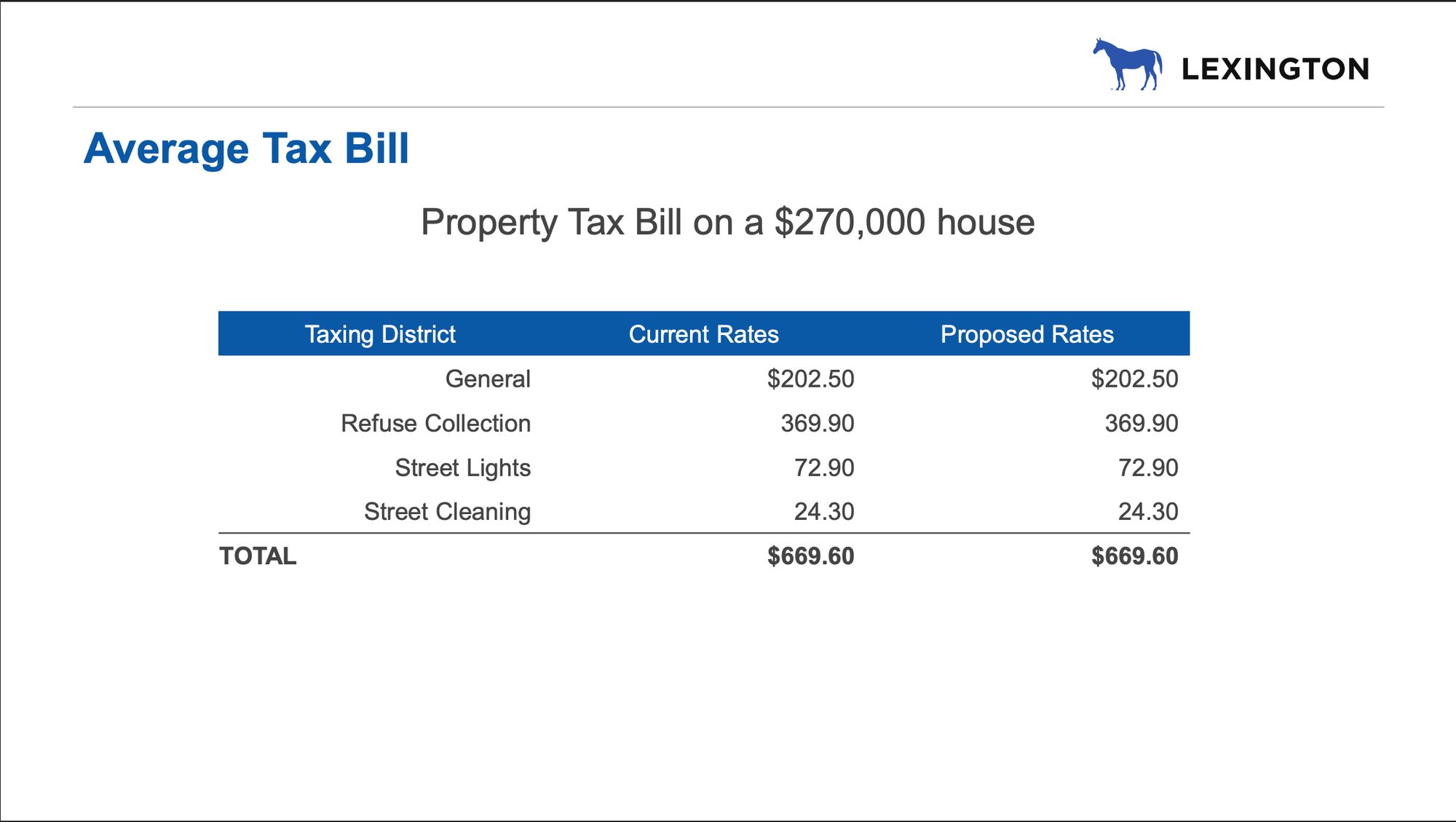
Taking the example of a $270,000 home again, the homeowner's property tax bill for Urban Services would be $467.10 under that rate.
So altogether, for a home valued at $270,000 under the proposed rate, the property tax bill would be:

Lexington has not lost any federal grant funding to date, but the city has experienced a "close call".

The newly approved budget ups spending for the city's winter storm response, and directs nearly $300 million for Public Safety, including fire, police and other divisions.

Lexington's Urban County Council approved several spending requests for the next city budget, including $135,098 for additional building security in city hall.

Among Councilmembers' budget requests: More than $141,000 for building security upgrades, $1 million for city vehicle fleet maintenance, and $1.5 million for ADA compliance.