The Office of Homelessness Prevention and Intervention has made improvements with a new position and will adopt new recommendations from the Mayor's Task Force on Homelessness
Update: September 9th, 2026 During its meeting on September 8th, Council's General Government and Planning Committee advanced the proposed updates to Lexington's regulations for drive-through facilities. They will be reviewed by the full Council at a future Work Session. You can read the proposed regulation here.
On Tuesday, September 8th, Councilmembers will get a look at new rules proposed for the city's drive-through facilities and drive-up windows.
As a presentation to Council's General Government and Planning Committee shows, Lexington's regulations for these types of businesses date to 1983 and warrant an update from the "one-size-fits-all" approach the current standards take.
💼
Download: You can read and download the packet for this meeting at this link.
Most notably, the changes propose defining drive-through facilities and drive-up windows as two distinct uses. For example, a quick-service restaurant with a menu board and pay window would be a drive-through facility, while a business with a simple pick-up window – such as a dry cleaner – would be a drive-up window.
Each use would have its own requirements for how many vehicles businesses have to accommodate in their drive-through lines, what city planners refer to as "vehicle stacking".
For some context, these changes come in response to House Bill 443, which the Kentucky General Assembly passed in 2024.
According to meeting materials, the law requires that "all regulations governing development plans be objective standards that can be reviewed ministerially."
A previous review led by Division of Planning staff found that existing regulations for drive-through facilities in particular were too vague and in need of an update.
Drive-up windows vs drive-through facilities
Put simply, the proposed tweaks to Lexington's zoning rules define a drive-up window as a single point of pickup for goods or services provided on site. There is no menu board or any area for ordering beyond the pickup point. All vehicle stacking and pickup would be limited to a single lane.
Examples include:
A dry cleaning business
Some restaurants (Chipotle, for example) that don't have menu boards. In Chipotle's case, you order ahead through the app and pick up your food at the window.
Separately, a drive-through facility has customers move through multiple stations at the site. According to the committee presentation, they're defined as facilities that include – but are not limited to – drive aisles, stacking areas, menu boards, order points, and pickup points.
Examples include:
Banks
Restaurants with an order point on site
Car washes
What's driving the change?
According to meeting materials, the city's current regulation on vehicle stacking areas was adopted in 1983, and it has not been changed in any significant way since.
The regulation reads in part: "For any use which utilizes a drive-in or drive-through window or service area, a vehicular stacking area shall be provided for a minimum of five (5) vehicles."
The city wants to move away from that one-size-fits-all, five-car minimum and allow for more flexible stacking requirements that reflect how modern drive-through businesses work.
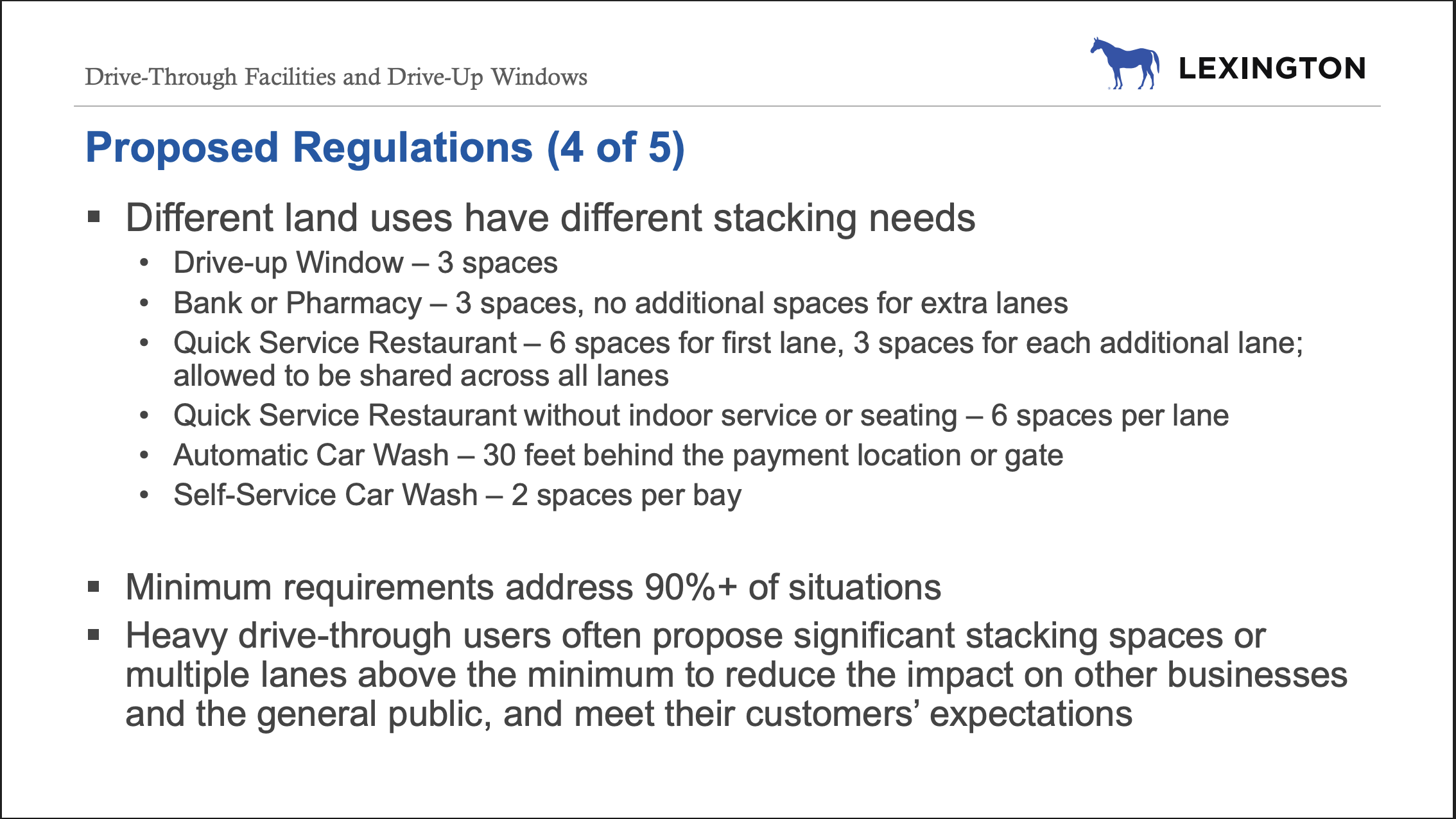
Per the presentation, some examples of vehicle stacking minimums include:
Drive-up windows: 3 spaces
Banks or pharmacies: 3 spaces, no additional spaces for extra lanes
Quick service restaurants: 6 spaces for the first lane, 3 spaces for each additional lane. The stacking spaces may be distributed across all drive-through lanes.
Automatic car washes: 30 feet behind the payment location or gate.
The presentation notes the minimum requirements are designed to cover most situations. There's also a process to pursue waivers for standard stacking requirements, subject to approval by the Planning Commission.
A screenshot from the presentation shows different vehicle stacking requirements.
What's next?
The changes will be up for review and discussion by Council's General Government and Planning Committee during its meeting on September 8th. The group will determine how to proceed with the proposed updates.
📺
Watch the meeting: You can attend the meeting in-person. It will take place at 1 p.m. in the Government Center at 200 East Main Street. You can also watch the meeting live on LexTV.
🫵
How can you get involved? You can reach out to your Councilmember to share your thoughts and ask questions. Find your Councilmember here.
Aaron covers the Lexington Fayette Urban County Council as a City Hall Reporter for CivicLex. His background is in Service Journalism, and he’s passionate about helping Lexington residents stay informed about happenings in local government.
Council is holding a special meeting October 6th to hear from the public about draft zoning updates related to data centers. It could take action on the issue as well.