Councilmembers will get a data center overview during September 8th's General Government and Planning Committee. They'll also take a look at what the Planning Commission proposes for zoning updates.
The review comes amid heightened scrutiny of Flock Safety and after a group of residents spoke out at a Council meeting on the city's partnership with the company.
Lexington's public transportation agency is Lextran. Founded in 1972, the agency has provided bus and paratransit service to residents throughout Lexington.
Lextran's primary services include a fixed-route bus service and Wheels, a paratransit service that picks up and drops off residents with severe disabilities who are unable to use the fixed-route bus service. In Fiscal Year 2025, there were ~3.5 million rides taken on Lextran buses and ~170,000 trips using Lextran's Wheels service.
Lextran is primarily funded through a property tax of 6 cents per $100 of taxable property. The property tax revenue represents roughly 70% of Lextran's annual budget. In Fiscal Year 2025, that tax brought roughly $25.5 million in revenue to Lextran.
Other sources of funding for Lextran include:
Federal funding (14% of Lextran's budget)
State funding (5%)
University of Kentucky's partnership with Lextran to provide free bus service for all students and employees (7%)
Passenger fares (3%)
Other small revenue sources (3%)
Why does Public Transportation matter?
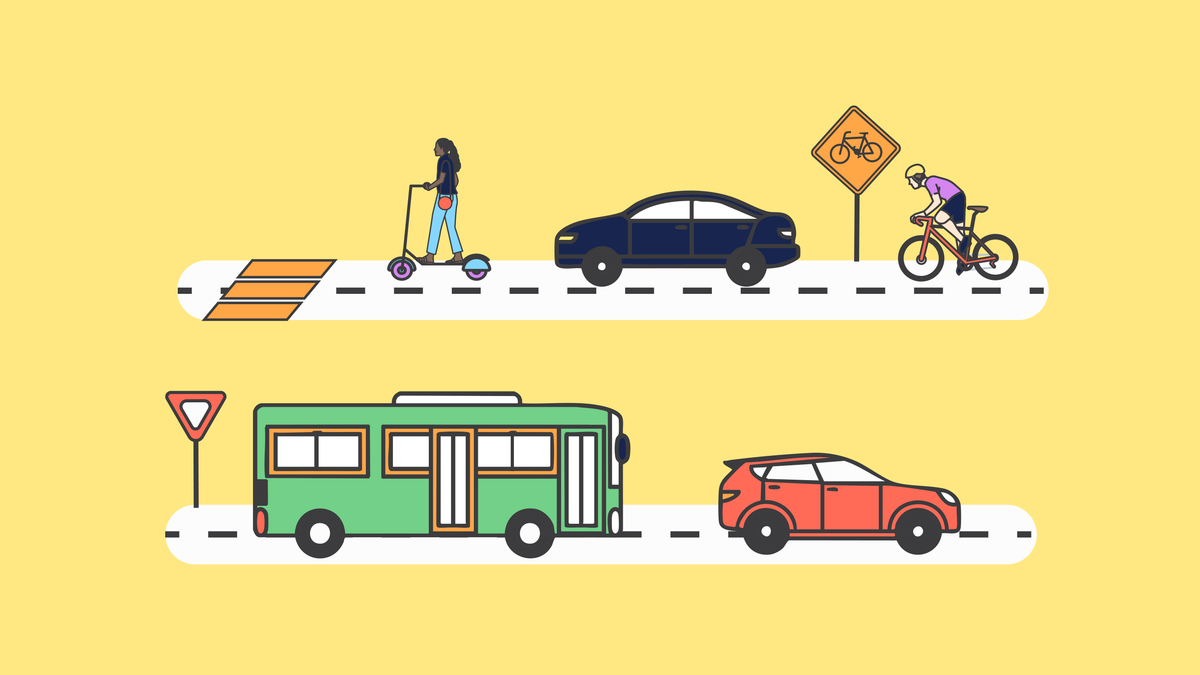
Nationwide, cities are reevaluating urban transportation. Since the 1950s, transportation networks have primarily been planned in order to move cars quickly. Other modes of transportation, including walking, bicycling, and public transportation, were deprioritized.
But there is growing interest in expanding public transportation infrastructure, including in Lexington! Why is that the case?
In our 2022 On the Table survey, Public Transportation was the second most discussed topic. In an analysis of the survey's Public Transporation data, Krasi Staykov found:
"[On the Table] respondents were overwhelmingly in favor of increased public transportation. Only 16 of the 1744 responses, or .05%, advocated for a reduction or removal of public transportation infrastructure. An addition 6 responses, or .03% advocated for a reduction or removal of bike infrastructure.
There were several recurring themes for what improvements to public transit respondents were suggesting. The most popular suggestions were:
Adding more bus routes, particularly routes that would avoid downtown transfers
Adding more bus stops along existing routes, particularly inside New Circle Road
Improving bus stops and the transit center, including seating, covered waiting areas, sidewalk access, and lighting.
Increasing the frequency of existing routes
How can you get involved in Public Transportation?
If you want to get involved in Public Transportation decisions in Lexington, here are some good places to start!
Reach out to your Councilmember about public transit. While LFUCG has no direct authority over Lextran, they have frequently supported projects for Lextran and do have the authority to approve or reject Lextran's annual budget.
Most people use public transit to commute to work. Since downtown Lexington is the major economic hub of the city, having most routes meet downtown helps employees access downtown's job opportunities.
Downtown Lexington is also the geographic center of the city. If you want to go from Hamburg to Nicholasville Road, for example, downtown is a middle point of that journey and is a logical place to have route transfers for cross-town riders.
The MyStop app, Transit app, and Google Maps can all give you directions on how to get from one place to another using Lextran's bus system.
Each app also shows real-time information on where buses are, if they are late or on-time, and when they will arrive at your nearest bus stop.
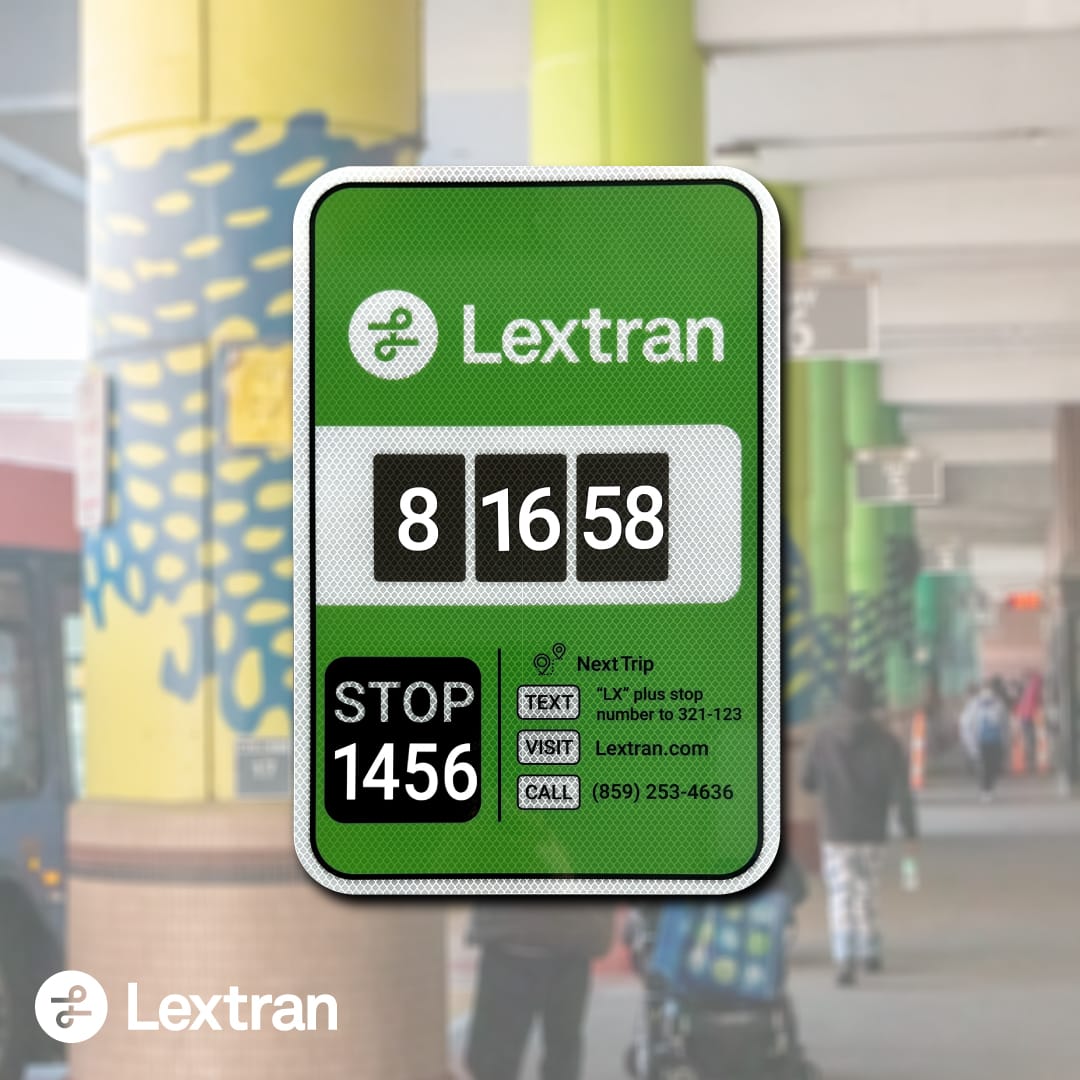
If you can't access any of these apps, each bus stop has an assigned number. Riders can text "LX" plus their bus stop number to 321-123 and receive a text back with updates on when the nearest bus is expected to arrive at the stop.
Each bus stop tells you what bus routes use that stop.
Information you can find on Lextran's bus stops. Source: Lextran.
Lextran rides are $1 per trip for adults.
Riders can either pay in cash on the bus (only in $1 and $5 bills), or buy a pass either online or in-person. Available at many locations, riders can purchase passes at Lexington Kroger stores and the Loudon Administrative Office.
Reduced fares are available to senior citizens, those with disabilities, veterans, students, and those on Medicare as long as the rider shows the bus driver a valid ID.
University of Kentucky students and employees are able to ride all Lextran buses for free, so long as they show the bus drive their UK ID.
You can view this YouTube video from Lextran with more step-by-step details on how to ride a Lextran bus.
An important etiquette expectation mentioned in the video is keeping in mind that the seats in the front of the bus is priority, accessible seating, reserved for people who may not be able to walk to the back of the bus.
How can you use Lextran Wheels?
Wheels is Lextran's paratransit service. It specifically caters to those with disabilities, providing them with a door-to-door service they can make reservations for. Wheels is a contracted service, meaning Lextran pays a separate agency to operate the service.
There is no comprehensive list of what disabilities allow someone to qualify for Wheels service. Instead, someone applying for Wheels must have a doctor's note verifying that they have some kind of disability that prevents them from being able to use Lextran's bus system.
Trips using Wheels may be booked as early as 14 days prior to the trip, or by to 4:45pm the day before at the latest.
Fares are $1.6o each way for trips within ¾ mile of a Lextran fixed-route bus stop, and $2 each way for trips that start or end farther than ¾ of a Lextran bus stop
One personal care attendant (PCA) may ride for free, and companions may ride with any passenger at the same rate per person.
Wheels performance issues and microtransit
In 2022, RAPT Dev took over as the service contractor for Wheels. In 2023 and 2024, Wheels saw many performance issues such as late pick-ups for trips, drivers not arriving at all to pick up riders, and several vehicle accidents.
This resulted in the company being fined nearly $70,000 over the course of two months for hundreds of missed or excessively late pick-ups, according to the Herald-Leader.
In December of 2023, RAPT Dev was fined $32,100 38 missed trips and 182 excessively late trips (trips later than 30 minutes).
In January of 2024, thet fined $37,400 for 120 missed trips, 249 excessively late trips, four accidents, and five complaints for rude driver behavior.
Microtransit is a broad term used to describe public transportation that typically provides door-to-door or curb-to-curb service using smaller vehicles like cars or vans.
You can think of it as a publicly funded Uber or Lyft style service, where a rider could book a trip on an app and have a driver pick them up within 30 minutes of booking.
BUILD believes a microtransit service could fill existing transit gaps for people who live too far away from a bus stop who cannot afford private microtransit services like Uber or Lyft, and for whom Wheels is too unreliable.
Lextran funded a Microtransit Feasibility Study to outline what a microtransit service and a microtransit pilot project could look like in Lexington. You can read a detailed breakdown of the Feasibility Study here:
Lextran has consistently argued that they do not have enough funding to support a microtransit pilot or service. In the Fiscal Year 2026 Budget, Council allocated $250,000 to Lextran for a microtransit pilot.
The Feasibility Study estimated that a two year microtransit pilot project would cost roughly $2.3 million.
Lextran would need to find a robust source of outside funding, or a new source of revenue for themselves, to implement a pilot project similar to the one recommended in the Microtransit Feasibility Study.
Using Bluegrass RIDE to get to Nicholasville and Danville
The Lextranbus system serves the whole city of Lexington, but it doesn’t leave the Urban Service Area. An intercity or regional bus takes riders across county lines. The Bluegrass RIDE bus, for example, travels multiple times a day between Lexington, Nicholasville, and Danville.
The Bluegrass RIDE regional service runs between Lexington, Nicholasville, and Danville Monday through Friday, four times a day. Exact route times and locations can be found on the Bluegrass RIDE website.
The bus will leave each stop at the time noted on the schedule, and no earlier. Passengers should plan to get to their stop about 5 minutes early so they have time to board the bus.
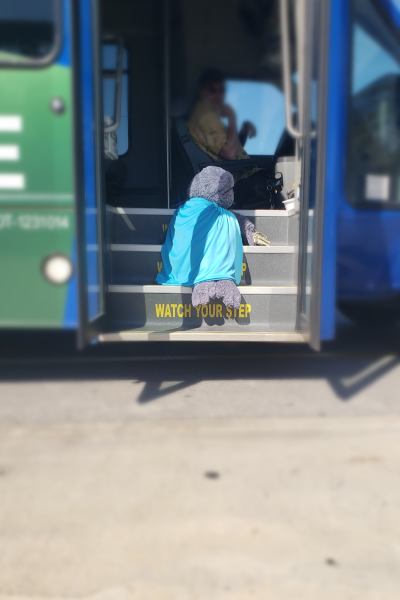
CivicLex's Sammy the Seal boards a Bluegrass RIDE bus!
The regional bus leaves the Lextran station at 10:47 AM, so Sami arrives around 10:45. The Lexington stops do not have any signs, so riders should make sure they are visible and keep an eye out.
Upon boarding, the driver will introduce themself and ask for the bus fare. These buses can ONLY accept cash, and they can not make change. There is no drop box, so hand this fare directly to the driver.
The Bluegrass RIDE bus stops four places in Jessamine County: